Right place, wrong time? Why timing in communication is everything

We’re all suffering COVID fatigue. It’s been one full year of living with pandemic protocols and, really, what we all need is to get through this period of time with as much grace as possible.

So, I’m curious as to why Prince Harry and Meghan Markle – and Oprah for that matter – have chosen this moment to air a special interview on the royals’ exit from the family and the U.K.

As communicators, we know timing is extremely important. When you choose to communicate to your target audience is just as important as key messages and why you are communicating.

It seems that this is the worst possible time for the L.A.-based royals to provide their narrative on why they left ‘The Firm’.  Prince Philip, 99, is ill and in hospital. The Queen, at 94 years old, is looking tired and frail. This interview, which is being described as a first-of-its kind, will most likely air dirty laundry that is cringe worthy at a time when we’re all in desperate need of good news and inspiring stories that fill us with joy and hope.

Right place, wrong time? Why timing in communication is everything

What the Oprah interview will do is most likely inspire very negative feelings – with most, I’m guessing, directed at Prince Harry and Meghan Markle. It may be hard for them to come across as anything other than spoiled, entitled and completely without compassion for Queen Elizabeth and Prince Philip.   

Are they attempting to enhance their brand, now that they’re no longer part of the royal family? If so, what does this timing do for their brand? Will it create a positive perception? Or, will they appear tone deaf? A solid brand can be seriously damaged with one negative incident, as we saw with BP in 2010. The Deepwater Horizon oil rig exploded, killing 11 workers and devastating the Gulf of Mexico, creating one of the worst environmental disasters in recent history. CEO Tony Hayward is remembered for his comment: “I just want my life back.”  

Yet, we also remember Michael McCain, CEO Maple Leaf Foods, who in 2008 led the company through a crisis which saw 22 Canadians die from listeriosis. These Canadians died after eating contaminated deli meats that originated at a Maple Leaf plant located in Toronto. We remember seeing a grim-looking Michael McCain in a taped television statement. His heartfelt apology and ownership of the crisis helped the company navigate a horrible moment in its history. He understood Canadians needed to see ownership, urgency and transparency in his words and actions. He earned enormous respect when he explained that he had ignored two sets of advisors: his lawyers and accountants. “The buck stops here,” he stated.

So we have to wonder, will Harry and Meghan’s interview engender respect? Will it earn them empathy? Will it enhance their brand?

Or, will it create a long lasting war of words with far-away family members at a time when most of us would rather hear of unity and actions that lead to greater good?

As a wise friend once said: every day, everything we do and everything we say can tilt the world to a better place, or a worse place.

With Harry and Meghan and the fallout from the interview, time will tell. And timing, as they say, is everything.
Why you want to add PR to your marketing mix

Your marketing is humming along, with a nice mix of advertising, social media and expert content. Why would you add PR? What are the benefits to your company and your brand?

Well, you will gain increased visibility. From a small, or even sometimes non-existent media presence you will go to regular and ongoing positive media exposure.  

You will also gain increased credibility. The media has vetted you and found you to be an expert. Canadians continue to watch, listen and read their trusted news sources as a part of daily life.

With the challenges of 2020, people are consuming mainstream news more than ever before. There’s a voracious need for news and updates on COVID, the U.S. election, Black Lives Matter activism and the need for action on climate change.  

With the challenges of 2020, people are consuming mainstream news more than ever before.

Will your company and its services stand out from competitors if you are not routinely interviewed by the media?  For one B2B client, it took only two media profiles before a potential client reached out and said ‘ok, let’s set a meeting’. It was a combination of visibility and credibility that eventually led to a step forward in the relationship.

If new and prospective clients are not hearing about you through positive media profiles, how will you relay your expertise, interesting stories, facts and trends that highlight your company?

With an effective and on-going PR campaign relationships are cultivated, enriched and are, in a perfect world, symbiotic.  Good stories shared with talented journalists result in engaging profiles.

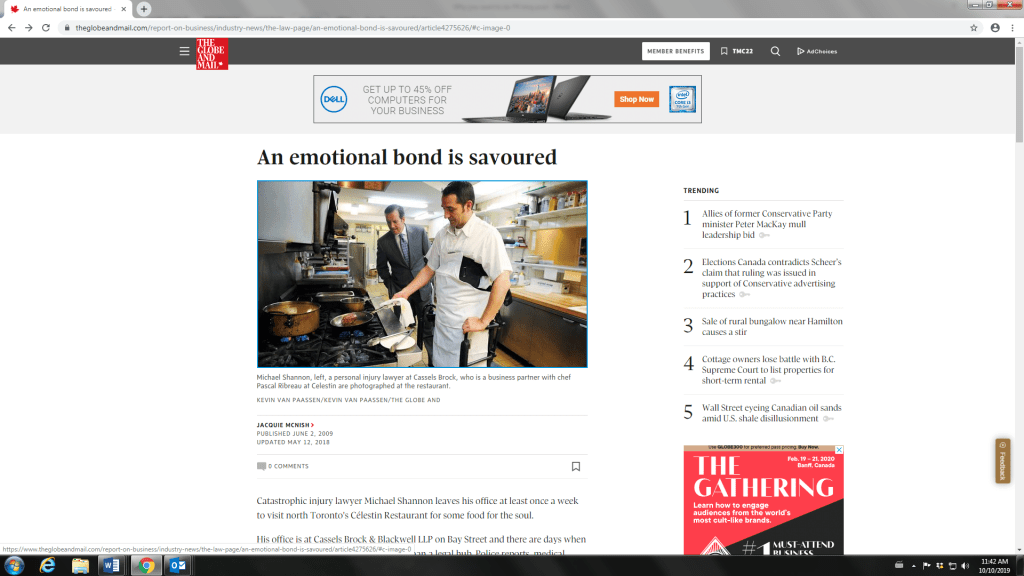
Here are a few of our favourite stories, starting with former client Cassels Brock and lawyer Michael Shannon, shown here:

It tells the story of a lawyer, working with a client to obtain an insurance settlement after suffering a catastrophic injury, and then going into business with him to open a restaurant:

Read the story here: https://tinyurl.com/yxbcj2cx

Here’s client TMG International Inc. highlighted on CTV news to discuss the failing grade given to the federal and provincial governments in regards to COVID and communicating to Millennials:

http://ctvnews.ca/video?clipId=2048771

Client Shulman & Partners LLP is profiled in this story and television interview detailing COVID and its negative impact on divorced parents and child custody arrangements:

https://tinyurl.com/y3of4r78

Client Kotak Law is featured in this interview, discussing the increase in mental health issues as a result of COVID. Unfortunately, mental health claims are still among the hardest to prove when it comes to making an insurance claim:

https://tinyurl.com/yyfb4tcg

What stories do you have that you want to share?

When a journalist tells us ‘you sure bring news I can use’ we know we’re on track

Just last month, one of our clients was profiled – in a positive way – to approximately 11 million Canadians.

How exactly did we do this? And how, exactly, does PR work? Once you’ve committed time and resources to PR, you’ve made a decision to enhance your company’s reputation with your target audience, through the media.

Here’s how it works:

First, we establish goals which include promoting our clients as the ‘go to’ interview sources due to their excellent reputations and credibility.  Then, we write compelling media releases and email pitches which are forwarded to reporters, editors and producers, resulting in positive media profiles.

The following are an initial list of goals for an effective PR campaign:

  1. Determine strong key messages via media training session.
  2. Highlight spokespersons and the company as well as a successful track record in the specific area of expertise.
  3. Increase positive media exposure of the spokesperson and company.
  4. Highlight the credibility of the spokesperson as an expert source to media outlets.

Then, we determine our solution for achieving goals. Here’s an example:

  • Arrange media training for spokesperson.
  • In a collaborative process with client, write a six-month media plan outlining next steps.
  • Write one media release per month highlighting a specific topic; email pitches to journalists when news stories can be leveraged to highlight the spokesperson.

Project Management/Tactics:

Daily:iAMBIC checks media outlets daily for news stories which can be leveraged to benefit client.
Weekly:When appropriate, highlight client and its spokesperson(s) to media outlets.
Monthly:One Media Release per month disseminated to media list. A PR Activity Report will outline who was contacted and the results.

The results are positive media profiles, on an ongoing basis, for our clients.

Recently, one iAMBIC client achieved the following media coverage in a period of one month:

  • Seven-minute interview on BNN Bloomberg
  • Interview by National Post
  • Interview by the Toronto Sun
  • Interview by CTV news
  • Four-minute interview by Newstalk 1010
  • Four-minute Interview by CHCH television morning show

The total number of Canadian viewers/readers/listeners for the above is: approximately 11 million.

To quote an online Canadian journalist, who we pitched recently in regards to one of our clients:

“You sure bring news I can use.”

A 6-minute crisis preparation exercise (because it’s 2020)

Guest blog post by: Jacqui d’Eon

Preparing for a crisis can feel like a daunting task. But, what if I were to tell you that you can get a good head start in the time it takes to have a coffee break? Would you give it a try?

Since you decided to read more, I will take your answer as a “yes”.  Grab your coffee, a pen and paper and follow this six minute exercise:

Activity 1. Time = 1 minute

Using the list below, choose the three risk categories most likely to impact your organization.

  • Technology/cybersecurity – personal data security, information leaks
  • Health, safety, environment – office air quality, pandemics, office security
  • Natural/operational disasters – fires, floods, storms, workplace violence
  • Quality, product – tampering, patent infringement
  • Financial – fraud, financial malfeasance, purchasing irregularities
  • Industry/member issues – regulations affecting industry, industrial accident, technology disruption
  • Employee relations/labour disputes – sexual harassment, racial discrimination, scandalous behaviour, employee activism
  • Legal – trademark, patent or copyright infringement, claims of unfair or improper competition, corruption, bribery, tax evasion
  • Ethics/social – special interest group targets, member or industry-wide issue, demonstrations
  • Miscellaneous – executive behaviour, travel policies, expense policies

Activity 2. Time = 1 minute; elapsed time = 2 minutes

Now, plot the three risk categories you chose on this “heat map”.

Activity 3. Time = 3 minute; elapsed time = 5 minutes

Take the risk category that was the highest impact and highest probability on your heat map and answer these six questions about it.

  1. What might happen?
  2. What it would mean to your organization in business terms?
  3. What are your objectives for recovery, if this happens?
  4. What are we doing now or what should we be doing to prevent this from happening?
  5. What checks do we have in our policies, work processes, etc. to monitor the risk level/mitigate?
  6. Who is accountable for the ongoing monitoring and/risk recovery?

Activity 4. Time = 1 minute; elapsed time = 6 minutes

Take a sip of your coffee and congratulate yourself. Your ability to anticipate what might happen is confirmed.

Now wasn’t that easy?

What is Media Relations?

What do you do if you’ve got a hot news tip? What do you do if you’ve got a hot news tip that will shine the media spotlight on you and your expertise?

If you plan to email a reporter or editor, beware: at any given moment, journalists are drowning in email and not likely to read – or respond to – your pitch.  If you’re not including who, what, when, where and why in the first few sentences you’ve failed your mission. Journalists want you to get to the point, fast.

Here’s a sample headline, from a recent media release:

It’s complicated: instituting a dress code is fraught with difficulties’

This headline detailed the topic in a 700-word Media Release, which highlighted an area of contention in the employer/employee relationship. As a result of this Media Release, our clients were interviewed by major, national media outlets.  

Media Relations, which refers to the relationship that we develop with journalists, is important because it helps ensure emails are read and pitches and story ideas translate into interviews.

While Public Relations extends the relationship beyond the media to the general public, Media Relations is laser focused on building positive, collaborative relationships with journalists.  The goal for all is to share a great story with a highly credible spokesperson as an interview source. Weave in the right message at the right time and the end result is an engaging, educational story that leaves readers, listeners and viewers better informed.

I read The Globe and Mail every day. Consider this: an interview in The Globe and Mail will net your company positive exposure to millions of Canadians, as it is our country’s most-read newspaper. In fact, 7.1 million readers (print and digital) scan the outlet weekly.

Positive media profiles are still more important than advertising and other forms of marketing as they provide the all-important third-party validation.

Positive media profiles are still more important than advertising and other forms of marketing as they provide the all-important third-party validation. If a media outlet is profiling you – then you’ve been stamped ‘credible’. Your brand and image are immediately enhanced. We all know online reviews can be faked and advertising wasn’t created to be transparent, which means a positive media profile is the only way to connect with your target audience in an honest, authentic manner.

To be clear – Media Relations can be conducted proactively on a regular basis and, reactively when crises hit. Crisis communications takes over when an event (or series of events) prevents the normal operation of your company and may also, simultaneously, have serious consequences (reputational, financial, and human).

When considering Media Relations ask yourself: do I want to build, protect or enhance my reputation, or that of my company? Do I have success stories I want to share? When looking to hire a consultant, ask yourself: does this person have strong writing skills, combined with passion, integrity and know-how? Will it be a fun, exciting process?  It definitely should be – just ask our clients.

Messaging During this Pandemic: Is it working?

We are bombarded on a daily basis on the do’s and don’ts of daily life during this pandemic. From our elected officials to health experts and health editors and reporters, we’re offered daily messaging on how to stay safe and keep others safe as well.

All PR is the development and maintenance of effective communication with representatives of the media, through to your target audience. The issue is: how effective is the messaging around  COVID-19?

In 1918, the pandemic known as the Spanish flu included communication in the form of posters and flyers.

With COVID-19 and our ability to disseminate comprehensive communication in an accessible manner, why is it that messaging differs from country to country, and even city to city?

In Canada, each province is fighting the pandemic in its own way with some emerging as more successful than others. Success today is defined as having your community understand the importance of physical distancing and displaying the willingness to stay home in order to protect each other from the virus.

Has our messaging been strong enough?

Why are some Canadians adhering to the stay-home policy while others are not?

According to Dr. David Williams, in answer to the question of why Ontarians are not going to assessment centres even when exhibiting symptoms of COVID: “perhaps Ontario Public Health’s messaging and communications weren’t as clear as it should be. ” He added that the agency is working to clarify its directions. 

Getting your message right during a pandemic is a matter of life and death.

Getting your messaging right:

  • Be sure your message is complete. Does it answer who, what, when, where and why.
  • Make your message crystal clear.  Don’t use jargon or technical terms.
  • Make your message concise.  Keep it brief and easily understood.

Effective communication is always important – at work and home. Right now, it’s a matter of life and death.

PR During a Pandemic: How to Pivot so Media Will Want to Profile Your Company

If PR is the development and maintenance of effective communication with representatives of the media, then how will you share your message during COVID-19?

In 2019, a NewsMediaCanada report stated that readership of Canadian newspapers was at an all-time high. During COVID, you can be sure Canadians are devouring news in all ways, including: social media, print, tv, online and radio.

But how do you pivot your PR initiatives during a pandemic?

  • You’re an expert in your field, and there’s information you can offer that correlates with the news cycle, so reach out to media outlets. Then, you’ll get the calls at 4 p.m. from reporters asking for quotes on relevant topics.
  • Keep in mind that with COVID-19 your media releases, emails and pitches MUST be relevant to the news cycle.
  • Do not issue non-essential media releases, launches and pitches.
  • Instead, look for ways to help.
  • Be human, be compassionate.
  • Think twice – is this the right time for you to tell this particular story? Know the news cycle by checking, on a daily basis, media outlets, blogs, twitter etc.
  • Understand the pressure reporters, editors and producers are under right now. Most are working from home and juggling family/work life as well as all the countless pressures related to COVID-19.
  • Be sure to provide an entire ‘package’ when pitching. Are you pitching your services as a psychologist offering a ‘how to’ on maintaining good mental health during a pandemic? Be ready to be asked if you have a document on your talking points ready to go to the news team.

Getting it wrong:

  • A grocery chain was called out by Ontario Premier Doug Ford (on national television and across social media channels) for price gouging on an essential disinfecting item.
  • Keep in mind if you make a mistake, and are in the news, you must repair your reputation immediately.
  • Do not shoot the messenger.
  • It’s all about apology and accountability. And, if possible, make amends. Could this grocery chain have donated sanitizer to women’s shelters? Or donated prepared meals to inner city hospital health care workers?
  • In business, we’re constantly working in either direction: building a relationship and then maintaining it – or, undermining it. We do this with every action.
  • Before you call, email or tweet make sure your ‘ask’ isn’t a one sided request.

Getting it right:

  • The Ontario Society of Professional Accountants is doing free tax prep for health care workers fighting COVID-19.
  • And, right now, 800 HCW in Ontario have tested positive for COVID-19. So, you can imagine how well received this offer will be.  This story was on the national news this week.

We need good news right now, to shine a light on how we all help each other in a crisis. How will you help? And, how will you share this news with media outlets?

Communicating in the time of COVID-19

“Rough waters are truer tests of leadership. In calm water, every ship has a good captain.” — Swedish proverb.

As we look around to examples of effective leadership and strong communication, it becomes clear that what most people want is information on how the effects of COVID-19 are being mitigated, how to stay safe in uncertain times, and reassurance that our health care experts and government leaders are trustworthy.

Canada’s Prime Minister Justin Trudeau has been effective, compassionate and composed during his updates to the nation. Ontario Premier Doug Ford has also delivered clear, concise information with obvious compassion and concern.

Most people agree that the top qualities a leader should demonstrate include courage, integrity, honesty, humility and clear focus.

“Rough waters are truer tests of leadership. In calm water, every ship has a good captain.” — Swedish proverb.

Here, we’ve compiled some recent quotes from our local and national leaders. How do they make you feel?

  • “Listening is your duty and staying home is your way to serve.” Prime Minister Justin Trudeau.
  • “Our window to flatten the curve of the epidemic is narrow.  We all need to act now. COVID-19 is a serious public health threat.” Dr. Theresa Tam, Canada’s Chief Public Health Officer.
  • “This was a very, very tough decision but it was the right decision. … We have your back. We will get through this together.” Ontario Premier Doug Ford.
  • “We will not raise a single price.” Loblaw CEO Galen Weston.
  • “When we say that you must stay at home for 14 days, that means you stay at home for 14 days. You do not stop for groceries. You do not visit your neighbours or your friends. You rest in your house for 14 days – no exceptions.” Patty Hajdu, Canada’s Health Minister.

In all our everyday communication, we convey thoughts and feelings. What feelings are you conveying?

What is PR?

What is PR?

I’ll let you in on a secret: PR consultants are so good at highlighting their customers online, in print, on tv and on the radio – that it looks like it happens without any effort at all. The majority of Canadians think people interviewed by a reporter happen to be in the right place at the right time when, in fact, it’s most likely the result of an effective PR campaign. So, basically, the better we are at our job, the less people know about the hard work happening behind the scenes.

PR consultants are so good at highlighting their customers online, in print, on tv and on the radio – that it looks like it happens without any effort at all.

We wouldn’t have it any other way. We want our clients to bask in the glow of positive media profiles. We strive to enhance clients’ reputations through media relations.

Essentially, we’re storytellers. We live to share interesting stories that resonate with our media contacts and their readers, listeners and viewers. On any given week, our company is pitching reporters and editors each and every day on behalf of clients. This results is positive media profiles.

Every day we:

Write media releases

Write email pitches, which are more personal

Write blog posts for clients

Create short, powerful videos

Create crisis strategies (with our trusted crisis expert)

So, if I had to define PR I would say that it is the development and execution of an effective communication plan, which outlines how and when we will regularly interact with media contacts to provide great story ideas that highlight our customers. This is done in a highly collaborative manner. Our client meetings, where we delve into topics, trends and emerging issues, are fun and interesting for all.

Through this flow of information, a company – as well as its products, services and people – are profiled in a positive manner in media outlets via Earned Media. We communicate the right message at the right time to the target audience. Our monthly retainers ensure that there is a consistent focus, by the media, on our clients. The ROI is enormous, as stated here:

According to Forbes* magazine: A recent study from 2014 by Nielsen commissioned by inPowered on the role of content in the consumer decision-making process concluded that PR is almost 90% more effective than advertising: “On average, expert content lifted familiarity 88 percent more than branded content…but I think that’s low.  With advertising, you tell people how great you are.  With publicity, others sing your praises.

With this Earned Media – any profile of you or your company that you have not paid for or created yourself – the impact is noticed immediately. That’s because Earned Media is more credible than advertising and therefore more powerful. In fact, Earned Media provides the all-important third party validation. And, while there’s no guarantee our story ideas will be picked up by reporters and editors – we work hard to ensure that they almost always do get selected. We base our success on outcome – not output.

For our clients, the icing on the cake is social media – the all-important amplifier of Earned Media.

Even in today’s noisy, information packed world, Earned Media is still a great way to explain and demonstrate a company’s credibility in a consistent, comprehensive manner. Canadians are still very influenced by media outlets and what they read, hear and see.